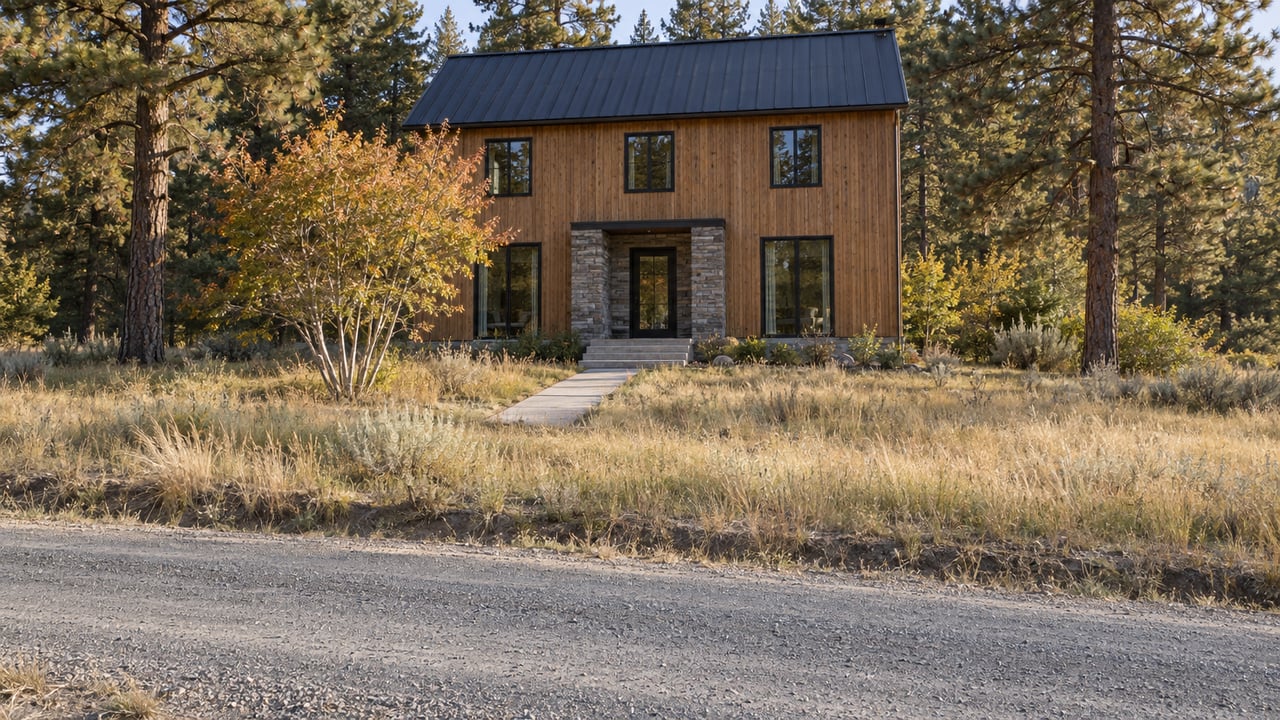
Athol's "No HOA" Land Listings Skip One Question: Who Grades the Road
October 1, 2026
October 1, 2026
Look at enough Athol acreage listings in a single sitting and a pattern turns up fast. Grand Fir Estates: 4.95 wooded acres, power in, community water available, and "no CCRs or HOA, giving you freedom to design." Broken Arrow Estates: five acres at the end of a private road, prized for its privacy. A handful of others repeat the same two lines almost word for word: no covenants, no association, build what you want.
The phrase reads like a bonus. What it actually signals is narrower than that, and buyers comparing bare parcels around Athol this fall are better served knowing the difference. "No HOA" tells you there is no board collecting dues right now. It does not tell you who plows the shared gravel after the first heavy snow, who pays to regrade it after spring runoff washes out the low spots, or what happens when one neighbor stops answering the group text about the bill. That question does not go away just because the listing never raises it.
Kootenai County's subdivision code does not leave private roads to informal goodwill, at least on paper. Under Title 8, sections 8.6.705 and 8.6.707 of the county code, any private road or common driveway created through a subdivision has to be dedicated to what the code calls a maintenance entity, and it has to meet real design standards along the way. Private road easements must run at least 60 feet wide. Common driveways need at least 40 feet and can serve no more than four parcels. A new dead-end road is capped at 25 parcels. And the county is explicit that none of this becomes its problem later: private roads carry a notation on the plat stating that no highway district will ever be obligated to plow, patch, or maintain them.
That single requirement, dedication to a maintenance entity, is the part that current marketing language tends to skip. The code does not say the entity has to be a homeowners association with a management company and a reserve fund. It can be an HOA, a water and road association, a land-share corporation, or a handful of owners with a signed and recorded agreement. But it is supposed to be something, named and dedicated at the time the subdivision was platted. When a listing says "no HOA," it is answering a different question than the one that actually matters at closing: not whether an association exists, but whether a maintenance entity was ever formed at all.
Not every Athol subdivision handles this the same way, and the differences show up in the listing language itself if you read closely.
The Estates at Farragut, a platted acreage community bordering Farragut State Park, presents itself as one of North Idaho's more organized rural developments, the kind of place where infrastructure and standards are part of the pitch. Kelso Lake Woods Subdivision goes further and names the shared asset directly: 60 feet of community lake frontage and a public dock reserved for subdivision residents, which only works if someone is formally responsible for that dock and the road that reaches it. Oakridge Manor advertises access to a community water system, meaning some collective structure already exists to run it, whether or not the word "HOA" ever appears in the listing copy.
Then there is the other pattern. Grand Fir Estates pairs "community water is available" with "no CCRs or HOA" in the same sentence, which is worth sitting with. A community water system does not run itself. Someone tests it, someone pays for the pump, someone answers the phone when it fails in January. That someone is an entity of some kind, even an informal one, whether the listing calls it that or not. The "no HOA" line describes the absence of a board collecting road dues. It says nothing about whether the water system, or the shared driveway that reaches it, has any formal maintenance arrangement behind it.
Even listings that sound reassuring can be vague in the same way. One 10-plus acre parcel off Contour Lane, near Granite and Kelso Lakes, is marketed with "great producing wells throughout the area, community maintained road, electricity to the property." Community maintained by whom, funded how, and enforceable against whom if a neighbor stops contributing are all questions the listing does not answer, because the listing is not the place where that gets settled. The plat, the recorded easements, and any road maintenance agreement are.
| Signal in the listing | What it actually tells you |
|---|---|
| "No CCRs or HOA" | No active association collecting dues right now. Says nothing about whether a maintenance entity was ever dedicated on the plat. |
| "Community maintained road" | Someone has been doing the work. Does not confirm a recorded agreement, a funding formula, or what happens if that someone stops. |
| "Community water available" | A shared system already exists and is being run by someone. The absence of an HOA does not mean the absence of collective obligation. |
| "End of a private road" | Privacy is real. So is shared responsibility for the road that gets you there, whether or not it is formalized. |
| Named subdivision with shared amenity (dock, gate, water system) | More likely a maintenance entity was dedicated at platting, since the amenity itself requires ongoing upkeep. Confirm rather than assume. |
The clearest illustration of what organized maintenance costs when it is done formally sits just outside Athol proper, near Scenic Bay on Lake Pend Oreille. A small lakeside land-share community there, tucked between two marinas near Farragut State Park, runs on annual dues of $650. That figure buys a functioning entity: a recorded structure, a budget, and a mechanism for collecting from every owner rather than relying on whoever feels like grading the road that week.
When no entity exists, that cost does not disappear. It just does not have a name yet. It shows up later as an unplanned conversation among neighbors after a wet spring, or as a bill nobody agreed in advance to split evenly, or as a driveway that stays rutted through mud season because no one has the standing to hire a contractor on the group's behalf. None of that appears in a title search, because there is nothing recorded to search for. A title company can confirm an easement exists. It generally cannot tell a buyer whether the people who share that easement have ever agreed on who pays to keep it usable.
A few questions are worth asking before an offer goes in, not after:
None of this makes bare acreage a worse choice than a platted community with an active association. Plenty of buyers want exactly what "no HOA" promises: fewer rules, more latitude, lower carrying costs in years when the road needs nothing. The point is narrower. The freedom in the listing and the maintenance obligation on the plat are two separate facts, and only one of them is being advertised.
Does "no HOA" mean there are no ongoing road costs at all? Not necessarily. It means no association is currently billing for them. If multiple owners share access, someone still bears the cost of keeping that access usable, whether or not it is organized.
What if the recorded plat never named a maintenance entity? That is worth flagging before closing, not after. It usually means the obligation exists in practice but not on paper, which is harder to enforce if a neighbor stops contributing.
Can owners form a road maintenance agreement after the fact if one was never recorded? Generally yes, with the consent of the owners who share the road, though it takes more coordination after the fact than it would have taken at the time of platting.
If you are comparing acreage listings around Athol this fall and want a second read on what a specific parcel's plat and access actually commit you to, that is exactly the kind of question worth working through before an offer goes in rather than after. Stephen Vachon has spent enough time around North Idaho construction and land deals to know where these details tend to hide, and where to look for them on your behalf.
Stay up to date on the latest real estate trends.

Work with a trusted local expert dedicated to helping you navigate the market and achieve your real estate goals. Get personalized real estate support from start to finish, whether you’re buying, selling, or relocating in Coeur d’Alene.
STEPHEN H. VACHON
223 E Sherman Ave Coeur d'Alene, ID 83814